

Some Notes on Indexing.
I read a book about the history of the index and now it's all I want to talk about.

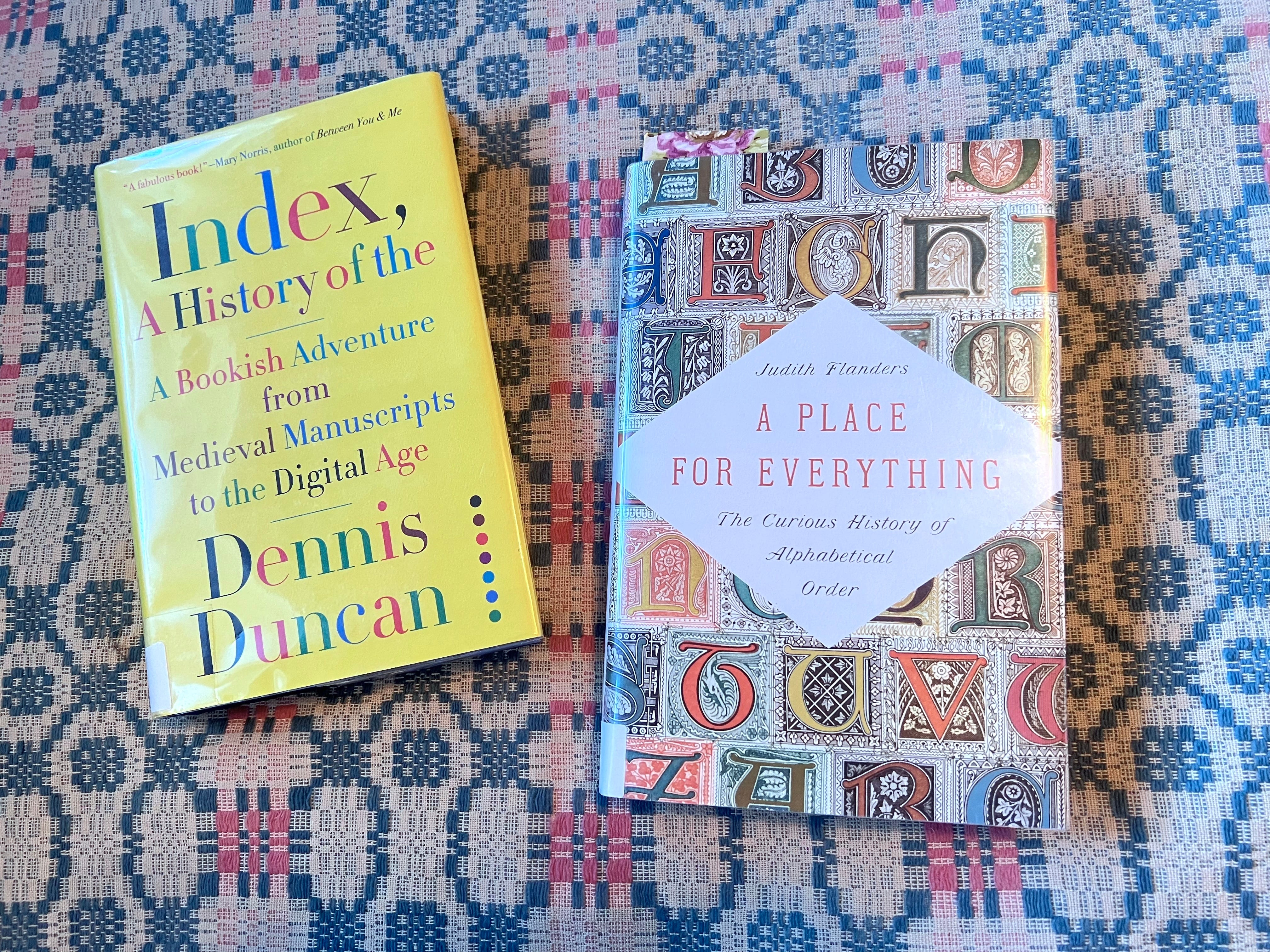
I. I finished a book about the history of the Index and then went straight into another about the history of alphabetization. I don’t think I will ever escape the nerdy librarian/archivist stereotype, as if I would ever want to. I am just so fascinated by the ways humans organize and access knowledge — I want to know everything about the history of it all, and then I want to take that knowledge and possibly use it in my own information management. What could be better than knowing the way you file or collate words is the same way monks in 14th century England did? I am the kind of romantic that swoons at that through-line stretching through centuries. The impetus is probably the same thing driving this urge for an “analog life” that we see all over social media these days — we’re all rotting our brains away on short form content, and wanting something more tangible. I think that, especially for those of us who can remember the before times, we are longing for those processes that have nothing to do with the internet.
II. After reading Index, A History of the, I can’t help viewing the profession of indexing as romantic — it feels old-fashioned in the best sort of way and, dare I say, analog. Imagine that your career is to read books so deeply and carefully that you are creating a map of its subjects, teasing out the message in its words and creating access points so that readers can move through the pages with intention. Dennis Duncan describes indexing as “devised to offer these agile, demanding readers not paths, but something instantaneous, non-linear - wormholes.”
III. If indexing can be romantic, it can also be a weapon — I learned that from the book, too. Duncan gifts readers with the concept of “ideological indexing,” and tells the story of Whig indexer John Oldmixon, who was given the job of indexing Tory historian Laurence Echard’s “History of England” in 1718. Oldmixon uses his index as a political weapon, deliberately satirizing and misrepresenting Echard’s narrative. A decidedly Tory historiography, at one point Echard tried to downplay and discredit the story of “the warming pan incident,” a 1688 conspiracy theory that accused Catholic King James II and his Queen Mary of smuggling a baby into the birthing chamber in a warming pan, passing the imposter off as the newborn prince. How could a baby fit in a warming pan, Echard reasonably asked? Preposterous! But Oldmixon, devoted Whig that he was, used the index to argue and satirize against Echard — the index entry for the incident reads: ‘Warming pan, very useful to King James’ Queen.’ If brevity is the soul of wit, then indexes are custom-made for it — they are “brevity incarnate” and “the perfect place for snark.”
IV. Sherlock Holmes created his own personal, universal index. Any subject, any idea, any person that caught his fancy was recorded and alphabetized so that he could reference it later. His index was vast and complicated, a scrapbook of newsclippings, biographical entries, and descriptions. It was how he was able to instantly recall and connect subjects and crimes. “Looking closely at Holmes’ index,” writes Duncan, “There is something charmingly, inescapably homespun about it. Victor Lynch, venomous lizard, Vittoria the circus belle: this is a rattlebag of headers: patchy, piecemeal…Holmes’ index brings together the collected readings and experiences of a single, albeit extraordinary, figure - the index as personal history.”
“The facts are briefly these: Some five years ago, during a lengthy visit to Warsaw, I made the acquaintance of the well-known adventuress, Irene Adler. The name is no doubt familiar to you.”
“Kindly look her up in my index, Doctor,” murmured Holmes without opening his eyes. For many years he had adopted a system of docketing all paragraphs concerning men and things, so that it was difficult to name a subject or a person on which he could not at once furnish information.
A Scandal in Bohemia


V. Duncan’s book also introduced me to the medieval polymath, philosopher, scientist, and theologian Robert Grosseteste, who is credited with early understanding of rainbows and the Big Bang, and as the creator of the first subject index in 1230. His Tabula distinctionum was an index to subjects and concepts in the Bible and 200 other works, including those by Church Fathers, Classical, and Arabic authors.
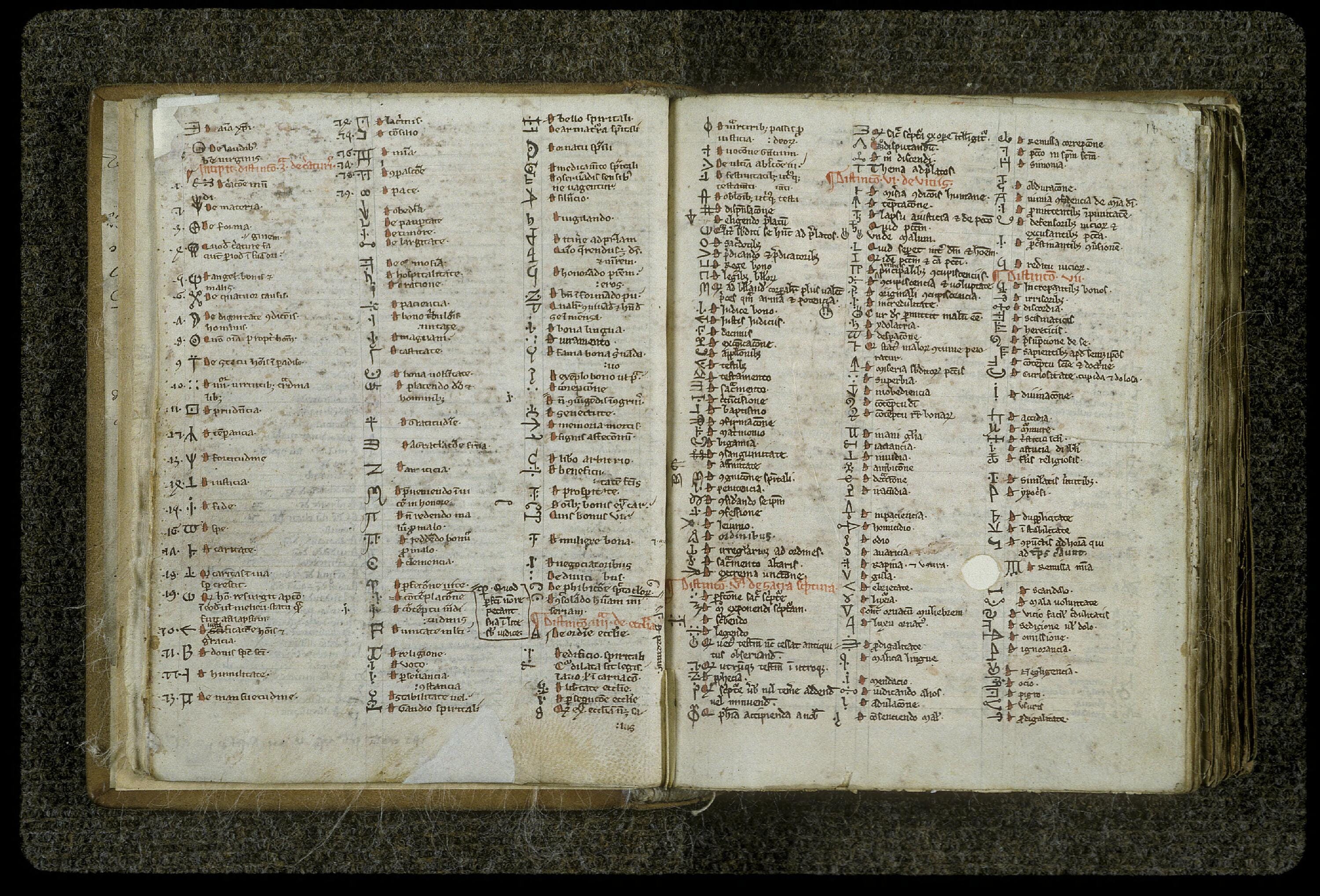
He created a system of annotation that relied on over 400 symbols to represent his nine “distinctions” (categories), which each had numerous subcategories. “All the letters of the Greek and Roman alphabets are used, plus mathematical signs, conjoined conventional signs, modifications of the zodiacal signs, and additional dots, strokes and curves.”1 Each symbol was linked to a list of references, where the concept could be found in the literature of the time. Grosseteste annotated his reading, which was prolific, by jotting down the symbols in the margins. This allowed him to go back and scan through his books to find the references to include in his Tabula index. I’m not big on annotating books (I read too many from the library to be writing in the margins), but I do love the idea of creating a system of symbols for quick reference points!
V. I’ll end these notes with a list, because we all know how much I love a list.
Medieval terms for an index:
repertorium
breviatura
directorium
pye
remembraunce
margarita
tabula
register

More from the Archives:


Hello, I love you:
Consider upgrading to a paid subscription to support this newsletter.
Or you could buy me a coffee, xoxo.
Find me on the silly app.
Send me an email: anchoressarchives@gmail.com.
Share this post, give it a heart, or comment!
This is an AI-free newsletter and it always will be.
The Writings of Robert Grosseteste, S. Harrison Thomson.
I requested this book from the library as soon as you mentioned it. This is the sort of thing I love ❤️
Delightful to open substack and immediately see this post, about a book I also finished reading a couple of days ago and really loved. I'm glad I'm not the only one left with stars in my eyes about indexes!!